
- Home >> News&Events >> Events
Significant Progress in Unraveling the Asynchronous Mechanism of Riverine Water and Nitrogen in the Agro-Pastoral Ecotone
River nitrate pollution is one of the most challenging water quality issues in the agro-pastoral ecotone, governed by both human activities and hydrological processes with strong spatial-temporal heterogeneity. In seasonally frozen river basins, the interplay of freeze-thaw cycles, precipitation, and agricultural activities has long rendered the coupling mechanisms of nitrate sources, transport, and export unclear, severely constraining integrated water and nitrogen management.
By focusing on the upper Luanhe River basin and integrating high‑frequency sampling with a suite of tracing techniques, the team elucidated, at a monthly resolution, the sources and transport dynamics of riverine nitrate. The average riverine nitrate concentration showing a distinct seasonal fluctuation, with peaking in winter and reaching a trough in summer. Spatially, concentrations varied with the intensity of human activities. They were highest in agricultural and residential areas, while approaching natural background levels in ecologically restored zones. Soil nitrogen and chemical fertilizers were the dominant sources. In intensive agricultural areas, the contribution of chemical fertilizers surpassed that of soil nitrogen, whereas soil nitrogen prevailed as the primary source in ecologically restored zones. Runoff components govern nitrate concentrations, with dilution prevailing during precipitation‑driven periods and concentrations rising when groundwater recharge dominates. However, total nitrate export depends entirely on total river discharge, not on water source proportions. The study further identified two seasonal coupling modes of riverine water‑nitrogen export. During the snowmelt season, when groundwater recharge dominates, a synchronous mode occurs, with nitrate being released gradually alongside groundwater discharge. In contrast, during the rainy season, which is dominated by precipitation recharge, an asynchronous hysteresis mode emerges, where nitrate concentration peaks appear before streamflow peaks, creating a typical water‑nitrogen mismatch phenomenon. Remarkably, the annual riverine nitrogen export constitutes less than 1% of the total nitrogen input, underscoring the role of the agro‑pastoral ecotone as a substantial nitrogen sink. Based on these findings, the team proposed a precise management strategy of “spatial zoning and temporal peak‑shaving”. In agricultural areas, fertilizer application should be reduced and advanced to before the rainy season to align with crop uptake; in ecologically sensitive zones, strict protection combined with dynamic monitoring is recommended. This work provides a theoretical foundation and data support for integrated water quantity‑quality management and ecological security in North China.
The above research findings, titled “Impacts of human activities and hydrological processes on monthly riverine nitrate sources and transport in the Agro‑Pastoral ecotone”, have been published in the Journal of Hydrology, a leading journal in the field of hydrology. Dr. Xiaole Kong, an assistant researcher in Min Leilei's research group, is the first author, and Professor Yanjun Shen is the corresponding author. This study was supported by the National Natural Science Foundation of China (Grant Nos. 42471041, U2544201) and the Natural Science Foundation of Hebei Province (Grant Nos. D2022503001, D2025503014).
Link to the original article:https://doi.org/10.1016/j.jhydrol.2026.135150
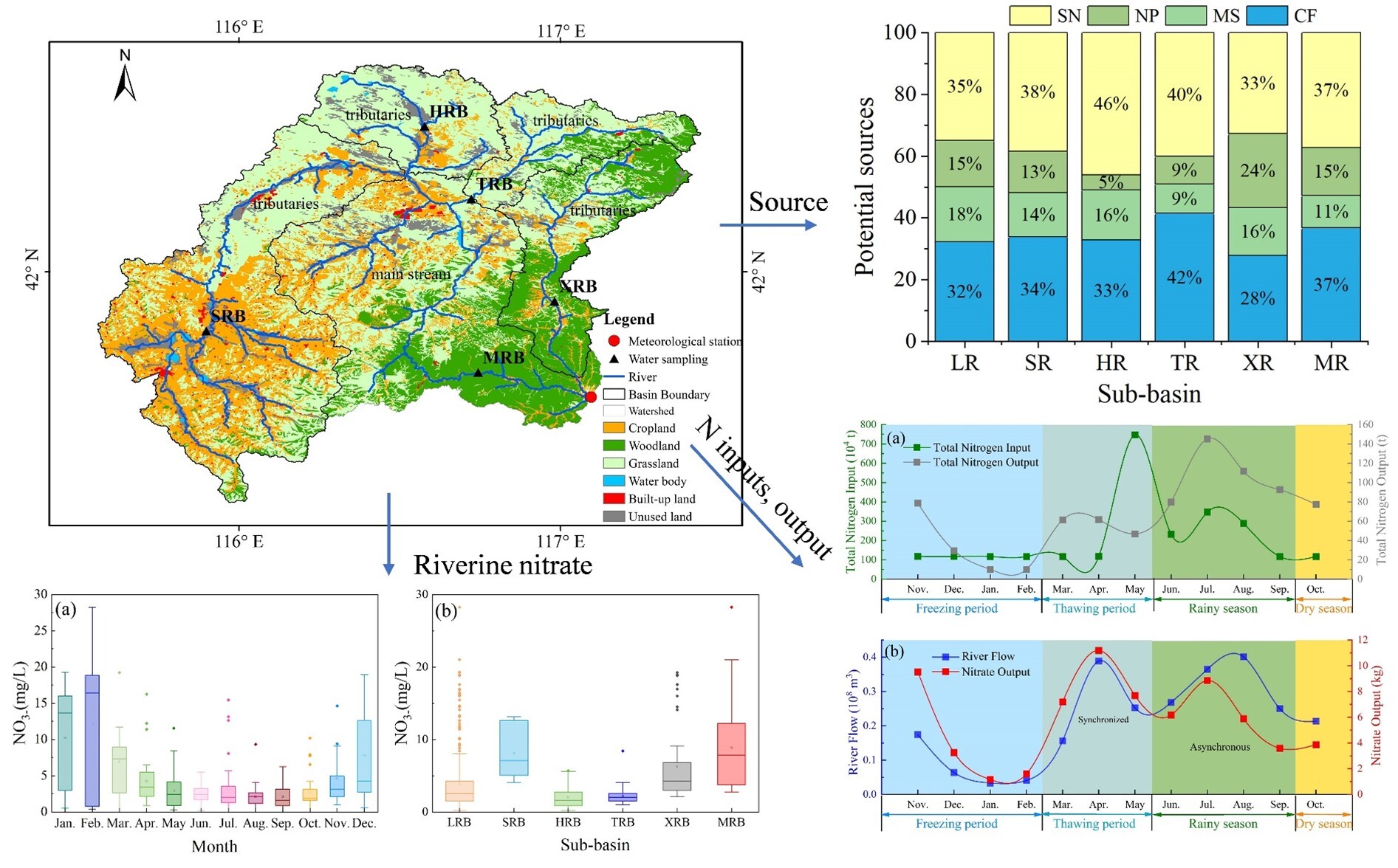
Fig Nitrate Concentration, Source Apportionment and Export Characteristics in the Luan
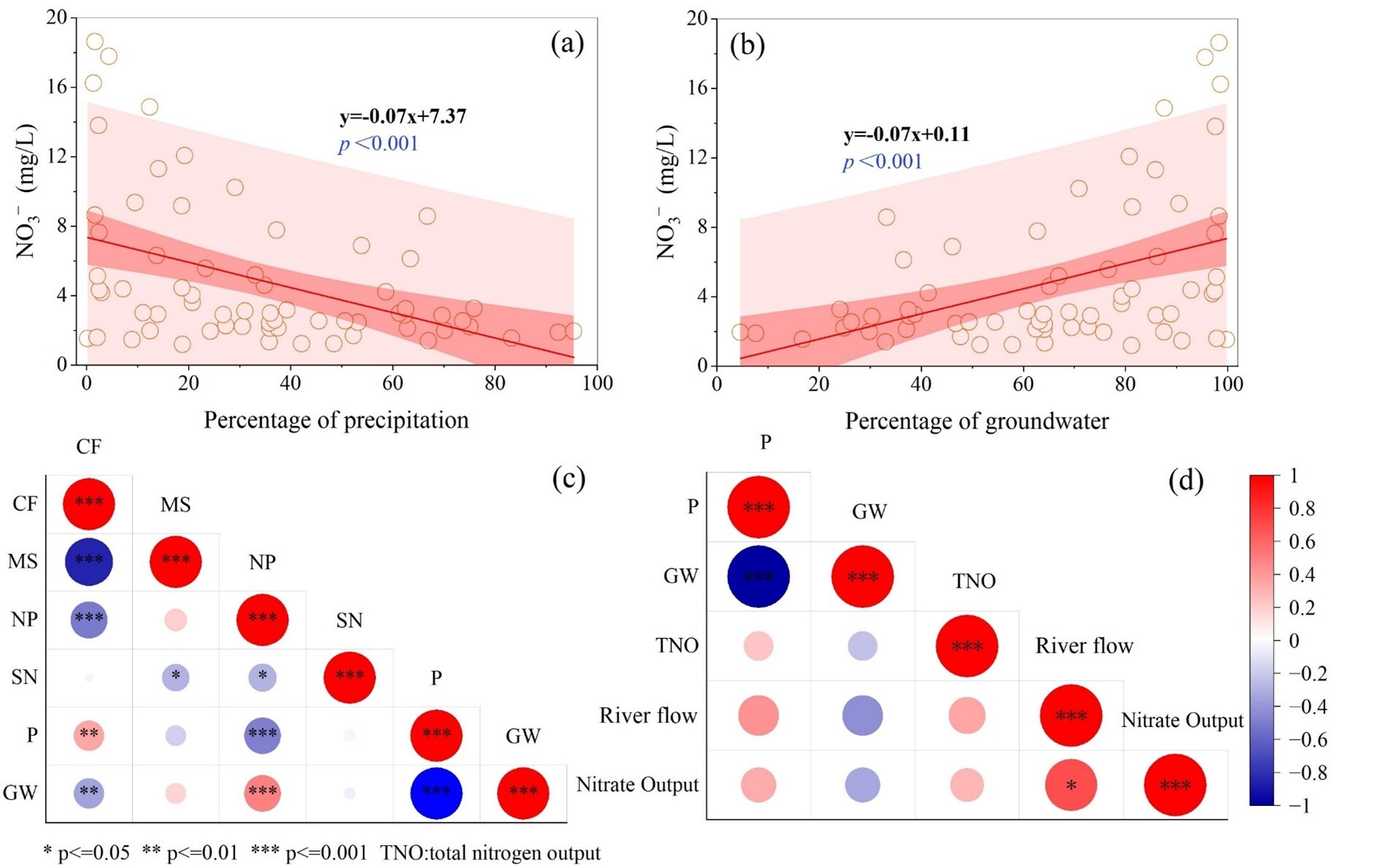
Fig Relationships between proportional river flow components (a, b) and nitrate concentrations. Pearson correlations of river flow components with (c) nitrate sources and (d) nitrogen outputs.