
- Home >> News&Events >> Events
Iron-loaded biochar redirects electron flow to retain nitrogen in paddy soils
In flooded paddy soils, denitrification converts nitrate to gaseous N₂O and N₂, whereas dissimilatory nitrate reduction to ammonium (DNRA) retains nitrate-derived nitrogen as plant-available ammonium. DNRA requires eight electrons per nitrate, compared with five for denitrification, and is therefore strongly constrained by electron supply. Enhancing interfacial electron transfer could redirect nitrate reduction toward DNRA and improve nitrogen retention in paddy soils.
A research team led by Prof. Shuping Qin at the Center for Agricultural Resources Research, Institute of Genetics and Developmental Biology, Chinese Academy of Sciences, loaded redox-active iron onto biochar and combined electrochemical characterization, ¹⁵N isotope tracing, and microbial analyses. Iron loading generated coexisting Fe⁰, Fe²⁺, and Fe³⁺ phases and increased specific capacitance and solid-phase electrical conductivity by approximately 1.8- and 6.0-fold, respectively. Iron-loaded biochar increased the DNRA rate from 0.29 to 0.94 mg ¹⁵NH₄⁺-N kg⁻¹ d⁻¹, a 3.2-fold increase, raised the DNRA contribution to nitrate reduction from 5.4% to 19.7%, and lowered cumulative N₂O production from 1.36 to 0.19 mg N kg⁻¹.
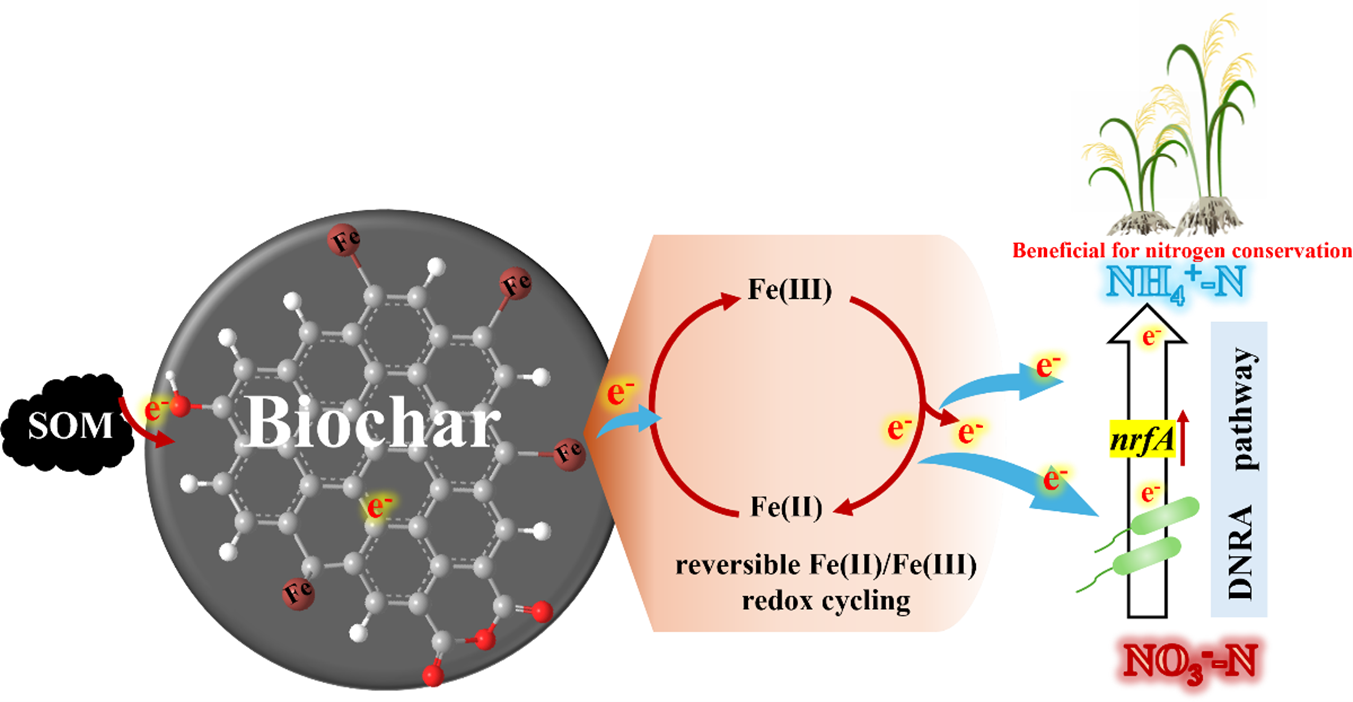
Figure 1. Proposed mechanism by which iron-loaded biochar enhances electron shuttling and promotes DNRA in paddy soil.
Iron-loaded biochar increased nrfA gene expression and enriched DNRA-associated microorganisms. Its stronger effect than iron-only controls at equivalent iron inputs revealed synergy between redox-active iron and the conductive carbon framework. The findings support a recyclable electron-shuttling mechanism that strengthens solid-phase electron transfer and redirects electron flux toward DNRA, although the role of Fe(II)/Fe(III) cycling requires in situ validation. This electron-flow perspective provides a basis for designing biochar that retains nitrogen while mitigating N₂O emissions.
The study was published in Communications Earth & Environment; Dan Yuan and Jiao Yuan are co-first authors, and Shuping Qin is the corresponding author.This work was supported by the National Key R&D Program of China (2024YFD1701100), the National Natural Science Foundation of China (42507446), the Hebei Province Central Guide Local Science and Technology Development Fund Project (246Z4206G), the Postdoctoral Fellowship Program of CPSF (GZC20251630), the China Postdoctoral Science Foundation(2025M772517), the Natural Science Foundation of Hebei Province (D2026503016), and the Postdoctoral Project of Hebei Province (B2025005034).