
- Home >> News&Events >> Events
Qin Shuping’s Group Makes New Progress in Understanding the Regulation of Soil Organic Carbon Priming
Soil organic carbon (SOC) is a major carbon reservoir in terrestrial ecosystems, and its decomposition and accumulation play important roles in the global carbon cycle. Agricultural practices such as straw return and organic fertilizer application, together with root-derived carbon inputs, continuously introduce fresh organic carbon into soils and can alter the decomposition of native SOC through the priming effect. However, although external carbon (C), nitrogen (N), and phosphorus (P) inputs can rapidly stimulate soil microorganisms, this microbial activation does not necessarily result in a proportional increase in native SOC decomposition. How microbial activation is translated into native SOC mineralization under different soil conditions remains poorly understood.
The research group led by Shuping Qin at the Center for Agricultural Resources Research, Institute of Genetics and Developmental Biology, Chinese Academy of Sciences, investigated this question using fluvo-aquic soils from Luancheng, Hebei Province, and black soils from Hailun, Heilongjiang Province, with low and high SOC levels. By combining 13C-labeled glucose tracing with extracellular enzyme assays and bacterial community analysis, the researchers examined the effects of different C-N-P inputs on SOC priming. C-enriched and CNP-enriched treatments induced strong positive priming, with CNP enrichment producing the highest cumulative priming effect. The influence of SOC level on priming was more pronounced in the black soil. C-N-P inputs also induced clear early responses of extracellular enzymes and increased the relative abundance of bacteria with acquisition-oriented strategies. Based on these findings, the researchers proposed an “activation-capacity” framework, in which the extent to which resource-induced microbial activation is translated into native SOC mineralization is regulated by native SOC status and associated soil properties. The study provides a new conceptual basis for understanding SOC priming under contrasting SOC backgrounds and for evaluating the carbon consequences of agricultural SOC management practices.
The study, entitled “Native SOC status modulates the conversion of C–N–P-induced microbial activation into priming effects,” was published in Industrial Crops & Products. Wei Song and Ruiyuan Zhang are co-first authors, and Shuping Qin is the corresponding author. The research was supported by the National Key Research and Development Program of China (2021YFD1500400), the National Natural Science Foundation of China (42507312), the Natural Science Foundation of Hebei Province (D2022503014), and the Special Research Assistant Program of the Chinese Academy of Sciences.
Article link: https://doi.org/10.1016/j.indcrop.2026.124030
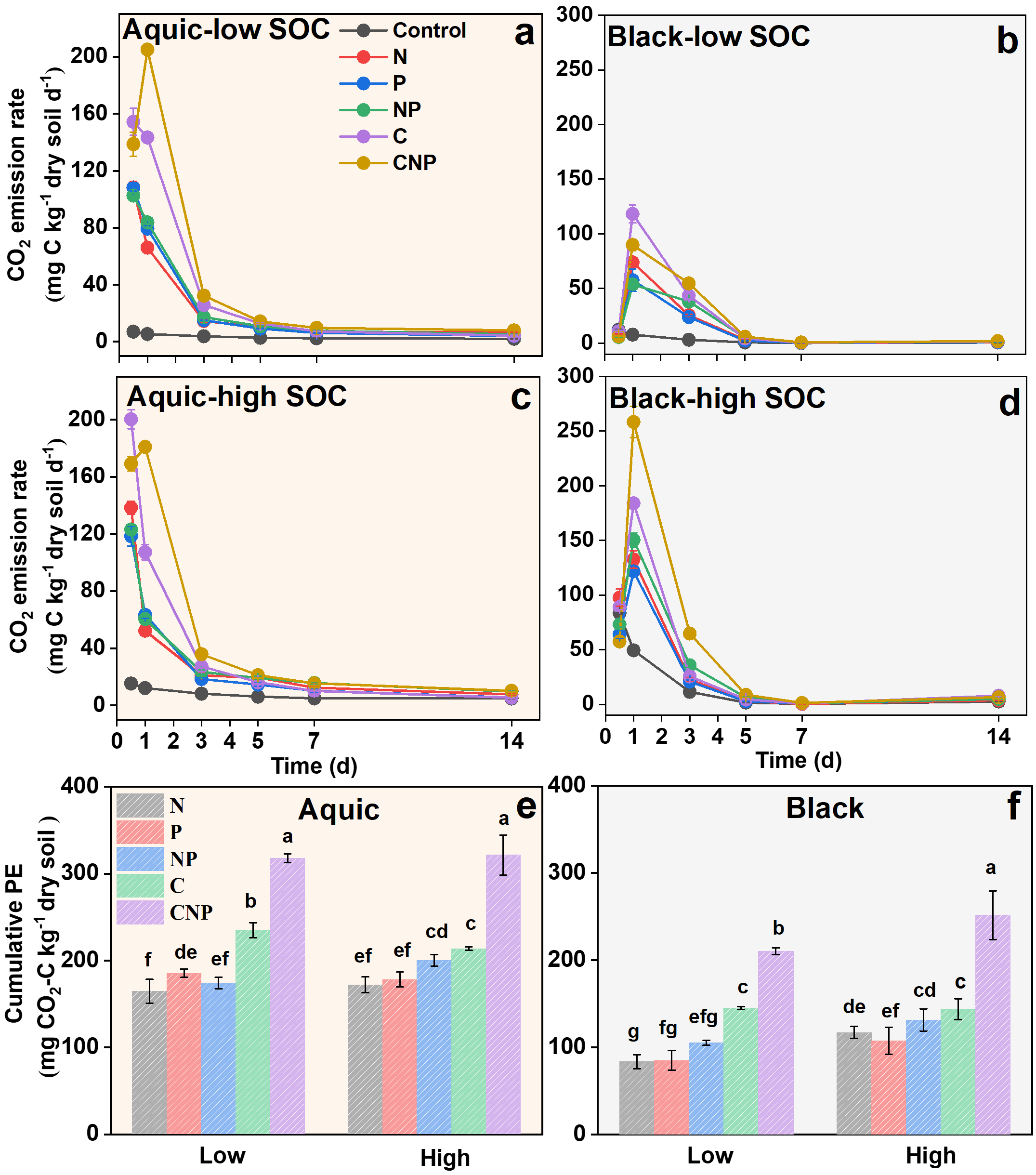
Fig. 1. Effects of different C-N-P inputs on soil organic carbon mineralization and priming effects.