
- Home >> News&Events >> Events
Geomorphic Setting Governs Nitrogen Leaching and Microbial Responses to Extreme Rainfall in the Deep Vadose Zone
Decades of intensive agriculture have left substantial stores of excess nitrogen in deep vadose zones. Extreme rainfall can rapidly mobilize this legacy nitrogen and transport it towards groundwater. However, predicting this process remains challenging in geomorphically complex watersheds, where contrasts in sediment texture, permeability and redox conditions can produce markedly different hydrological and microbial responses. In particular, how extreme rainfall reshapes microbially mediated nitrogen transformations across alluvial–proluvial and lacustrine sedimentary environments remains poorly understood, creating considerable uncertainty in assessments of nitrogen transport and groundwater contamination risk.
To address this knowledge gap, research teams led by Shiqin Wang and Binbin Liu at the Center for Agricultural Resources Research, Institute of Genetics and Developmental Biology, Chinese Academy of Sciences, investigated the Baiyangdian watershed in northern China. The watershed encompasses a distinct geomorphic sequence—from alluvial–proluvial fans and flood plains to lake depressions—and therefore provides a natural setting for examining how sedimentary architecture regulates nitrogen redistribution and microbial community responses following extreme rainfall.
Extreme rainfall displaced nitrate accumulation peaks into deeper soil layers, but the depth of nitrate penetration progressively decreased from the alluvial–proluvial fans to the lake depressions. In the highly permeable, coarse-textured sediments of the alluvial–proluvial fans and flood plains, preferential flow rapidly transported nitrate from the surface into the deep vadose zone, generating a new nitrate accumulation peak at approximately 10 m depth. Rainfall-driven mineralization was also enhanced in these environments, resulting in increased ammonium concentrations. By contrast, in the clay-rich lake depressions, the nitrate accumulation peak shifted only from approximately 3 to 6.5 m depth, whereas the predicted functional potential for anaerobic ammonium oxidation increased. These contrasting responses demonstrate that sediment texture and permeability strongly constrain both the depth of nitrogen leaching and the dominant microbial transformation pathways.
By integrating structural equation modelling with high-throughput sequencing, the study further resolved the spatial coupling between nitrate redistribution and microbial community reorganization following extreme rainfall. A distinct ecological boundary emerged at a depth of approximately 6 m. Above this boundary, microbial communities were highly responsive to short-term hydrological disturbance and changes in ammonium availability. Below 6 m, nitrate accumulation and redox gradients became the dominant environmental controls, supporting comparatively stable microbial communities with distinct functional profiles.
Microbial responses also differed substantially among geomorphic settings. In the coarse-textured alluvial–proluvial fans, rapid nitrate leaching directly triggered pronounced microbial community reorganization. On the flood plains, soil moisture emerged as a key regulatory factor, delaying the initial microbial response to environmental change while prolonging subsequent community adjustment. In the lake depressions, legacy nitrogen accumulated through long-term agricultural activity, together with relatively stable hydrological conditions, provided a natural buffering effect. Consequently, microbial communities in these environments were governed primarily by long-term nutrient accumulation rather than by episodic rainfall disturbance.
By placing nitrogen migration and microbial dynamics within a watershed-scale geomorphic and sedimentary framework, this study reveals how landscape position and subsurface architecture regulate the redistribution, transformation and potential attenuation of nitrogen following extreme rainfall. It further demonstrates that soil nitrogen redistribution and microbial community reorganization are closely coupled, but that the strength and mechanisms of this coupling vary systematically across geomorphic settings. These findings provide a scientific basis for developing geomorphology-specific strategies to mitigate nitrate leaching and protect groundwater quality under an increasingly extreme and variable climate.
The study, entitled “Geomorphic-sedimentary framework governs nitrate migration and microbial dynamics following extreme rainfall in the deep vadose zone,” was published in Agriculture, Ecosystems & Environment. Dr Kangda Tan is the first author, and Professor Shiqin Wang is the corresponding author. This work was supported by the National Key Research and Development Program of China (2021YFD1700500), the National Natural Science Foundation of China (42377080) and the Innovation Research Group Project of the Natural Science Foundation of Hebei Province (D2021503001).
Full article:
Tan, K., Wang, S., Lv, J., Zhang, Z., Liu, B., Zheng, W. & Liu, B. Geomorphic-sedimentary framework governs nitrate migration and microbial dynamics following extreme rainfall in the deep vadose zone. Agriculture, Ecosystems & Environment 407, 110409 (2026). https://doi.org/10.1016/j.agee.2026..110409
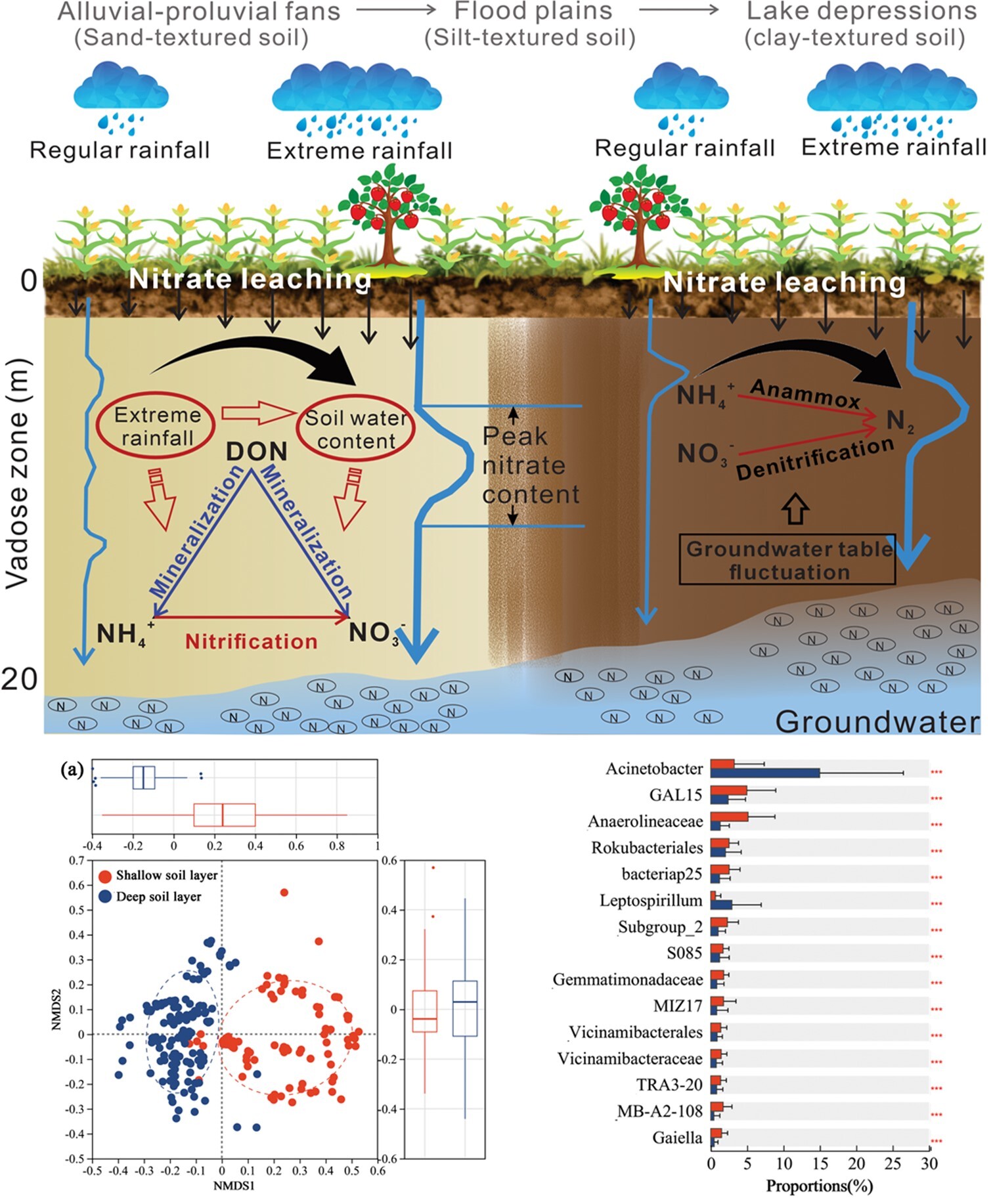
Figure 1. Responses of nitrogen leaching and microbial communities to extreme rainfall across geomorphic-sedimentary settings in the deep vadose zone