
- Home >> News&Events >> Events
Research team advances groundwater nitrate risk assessment and monitoring optimization by integrating agricultural legacy effects
Long-term irrigation and fertilization in intensive agricultural regions have resulted in persistent nitrogen accumulation in soils and vadose zones, with delayed impacts on groundwater quality. Because thick vadose zones slow water and solute transport, current groundwater nitrate contamination often reflects historical agricultural activities rather than only recent management practices.
Researchers from the Center for Agricultural Resources Research, Institute of Genetics and Developmental Biology, Chinese Academy of Sciences, led by Prof. Shiqin Wang, investigated groundwater nitrate risks in the plain area of the Baiyangdian Lake watershed by integrating groundwater observations, historical agricultural inputs, hydrogeological conditions, and machine learning approaches (Fig. 1). The study showed that irrigation and nitrogen application around the early 2000s remained important predictors of current groundwater nitrate concentrations, indicating multi-decadal lag effects between agricultural inputs and groundwater responses. Nonlinear responses were identified for irrigation amount (~300 mm yr⁻¹), nitrogen application rate (~265 kg N ha⁻¹ yr⁻¹), and groundwater depth (~16 m). Based on XGBoost-SHAP analysis, the researchers developed a risk assessment framework that identified high-risk areas and optimized the monitoring network from 278 to 82 sites while maintaining effective coverage of major risk zones and hydrogeological units (Fig. 2).
This study demonstrates that groundwater nitrate management in agricultural regions should consider historical water and nitrogen inputs, vadose-zone characteristics, and long-term groundwater responses rather than relying only on current agricultural conditions. The developed approach provides a scientific basis for agricultural non-point source pollution assessment, groundwater monitoring optimization, and targeted management.
The study, entitled “Agricultural legacies drive groundwater nitrate contamination: Machine learning and risk-informed monitoring optimization in the Baiyangdian Lake watershed,” was published in Agricultural Water Management (2026, 329: 110372). Zhixiong Zhang is the first author, and Prof. Shiqin Wang is the corresponding author. This work was supported by the National Key R&D Program of China (2021YFD1700500), the National Natural Science Foundation of China (No. 42377080), and the Foundation for Innovative Research Groups of the Natural Science Foundation of Hebei Province (D2021503001).
Full-text link
Zhixiong Zhang, Shiqin Wang, Zilong Zhang, Jingxiong Zhou, Bingxia Liu. Agricultural legacies drive groundwater nitrate contamination: Machine learning and risk-informed monitoring optimization in the Baiyangdian Lake watershed. Agricultural Water Management, 2026, 329: 110372. https://doi.org/10.1016/j.agwat.2026.110372
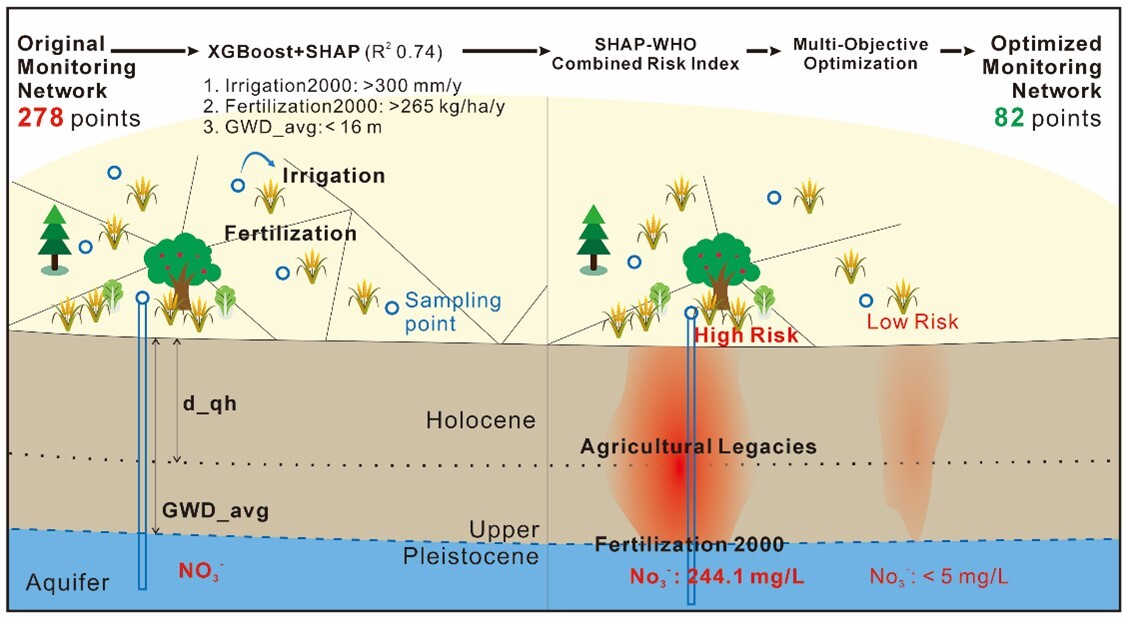
Fig. 1. Conceptual framework of historical agricultural inputs, vadose-zone regulation, and risk-informed groundwater nitrate monitoring optimization.
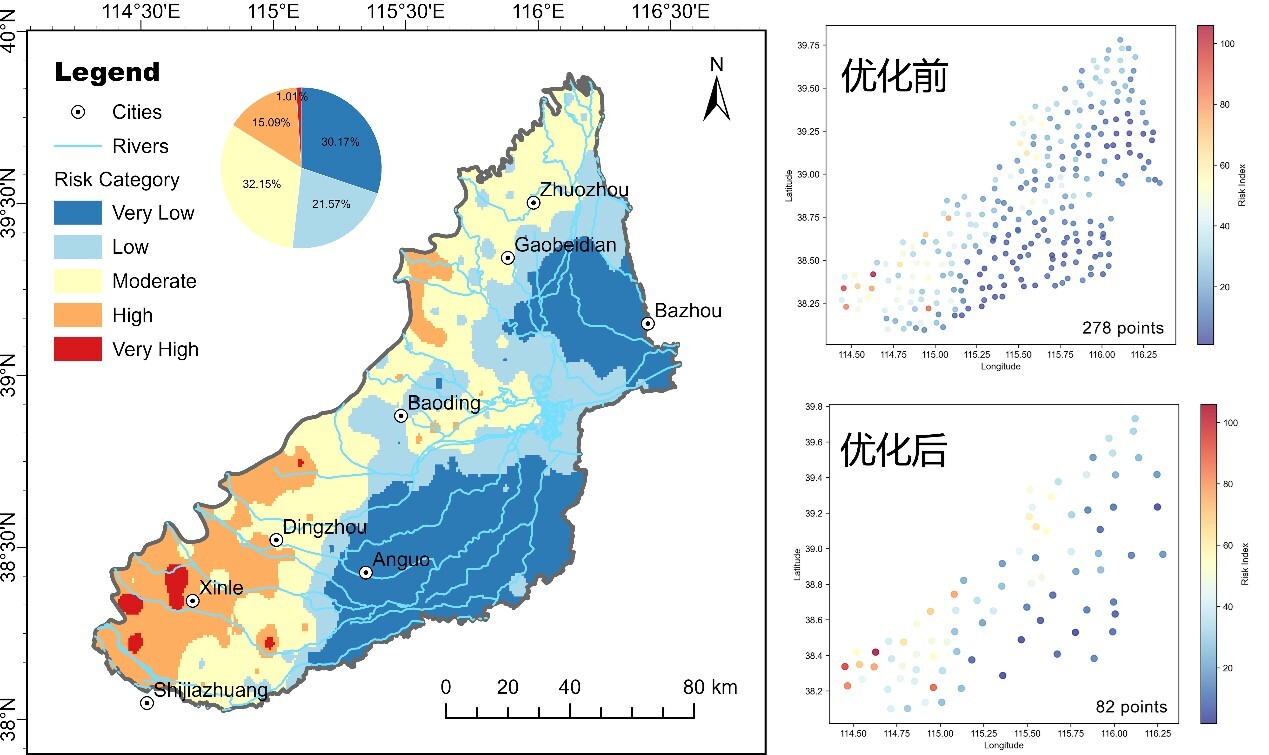
Fig. 2. Groundwater nitrate risk zoning (left) and optimized monitoring network (right) in the plain area of the Baiyangdian Lake watershed.